
Pancamukha Shiva — Lalita Kapilavai
© Lalita Kapilavai. Sacred Art & Carnatic Music Archive. Digital reproduction, automated screen captures, and unauthorized printings are strictly prohibited.
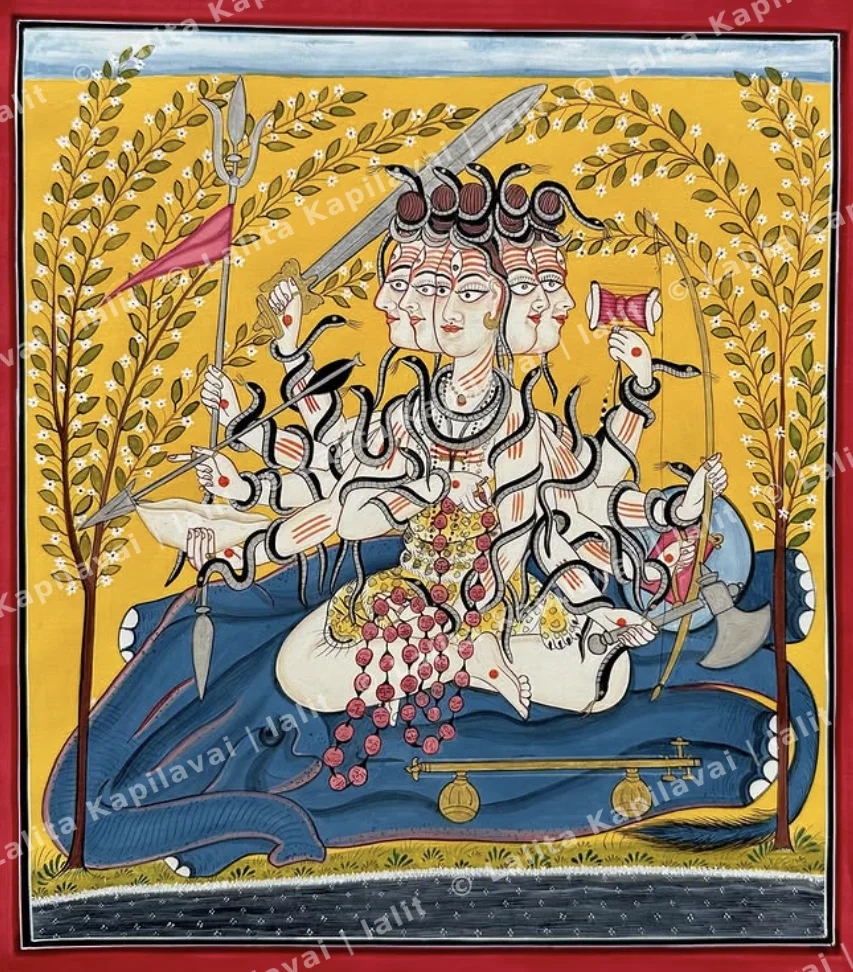
Pancamukha Shiva
Natural pigments, shell gold and shell silver on wasli paper • L= 24cms; W= 21.5cms
Pancamukha Shiva
Iconographic Commentary & Symbolism
Shiva is one among the trinities in the pantheon of Hindu gods who is always engaged in the five divine acts of creation, preservation, destruction, concealment and revealing. The five faces related to these cosmic activities are Sadyojata, Vamadeva, Aghora, Tatpurusha and Ishana pointing to the directions of north, west, south, east and space respectively.
Basohli artist conceived this tantric form of Shiva with five faces and ten arms. There is a creation myth associated with Shiva. The sacred syllable ‘Om’ emerged from the playing of Shiva’s drum while he performed the anandatandava during the creation. The entire universe was created from that primordial sound. A puranic musical instrument veena is symbolically placed in this painting suggesting this act of shiva.
He holds different attributes in his ten arms: garland of skulls, bowl of elixir, arrow, flag, sword, drum, bow, shield and axe. The tenth arm is left in his lap indicating a meditative gesture. His five faces are cleverly dealt by the artist with the central one in three quarters and the remaining four in profile. His body is coiled by many snakes and smeared with the sacred ashes. He is seated on a sprawling corpse of elephant as he is also known by the name Pashupati. The figure occupies the entire part of the painting while the artist tries to accommodate narrow strips of sky and foreground following the traditional suit.
