
Shrinath Ji — Lalita Kapilavai — Traditional Artist
© Lalita Kapilavai — Traditional Artist. Digital Atelier & Cultural Archive. Digital reproduction, automated screen captures, and unauthorized printings are strictly prohibited.
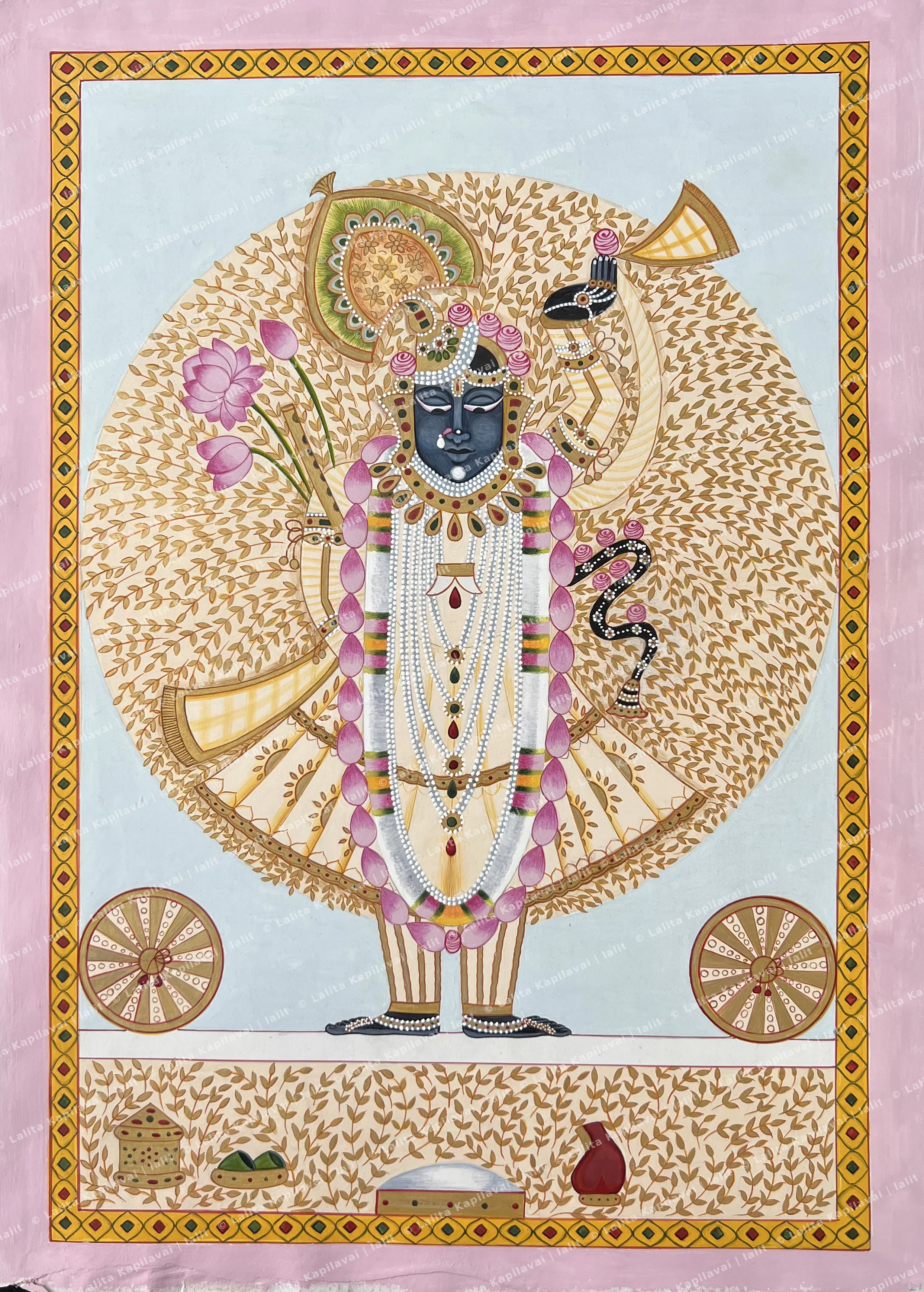
Shrinath Ji
Natural pigments, shell gold, on wasli paper • L= 40cms; W= 27.4cms
Shrinath Ji
Iconographic Commentary & Symbolism
Nathdwara is a seat of Krishna worship, extraordinarily enriched by a coherence of temple rituals and devotion blended with the tradition of Pichwai painting. In Pushti marg (Path of grace) tradition, Shrinath ji represents a seven-year-old child manifestation of Krishna. At Nathdwara in Udaipur, Rajasthan, he is seen in his anthropomorphic form dressed luminously in different attires many times in a day, each adornment associated with a particular ritual. Lovingly tending to him throughout the day is an act of devotion.
His raised left hand symbolizes the lifting of Mount Govardhan to protect the people of Braj from Indra’s torrential rains. His right hand rests on his waist denoting reassurance and grace. His large lotus-shaped eyes are open to behold everything. He is adorned with several rows of pearl strands, a garland of lotud buds, a peacock crown and is seen holding a flute. The two fore shortened bolsters on either side of the deity along with the pan box (Pan peti), bowls for Bhog or offering and water jar (Jhari) at the bottom are the daily ritual offerings provided to him as part of active temple worship. A moon-like orb decorated in patterns of gold surrounds Krishna and illumines his sacred form. The painting is surrounded by a traditional pichwai border.
Though Pichwai literally translates to ‘that which is hung behind’, it is also the name of the painting tradition associated with Shrinath ji at Nathdwara.
